
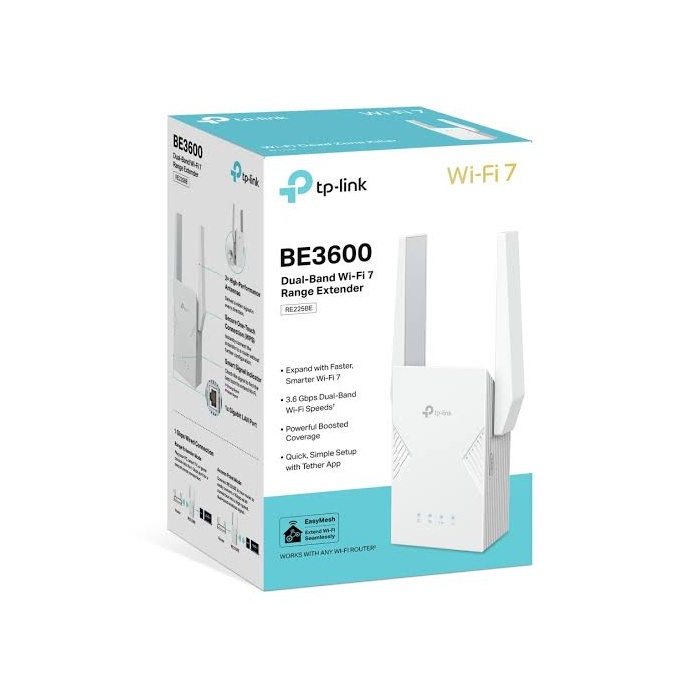
📡 Next-Gen Wi-Fi 7 Performance
- Wireless Standards: Wi-Fi 7 (IEEE 802.11be/ax/ac/n/a 5 GHz | IEEE 802.11be/ax/n/b/g 2.4 GHz)
- Combined Signal Speed: BE3600 (Up to 3.6 Gbps total wireless throughput)
- 5 GHz Band: 2882 Mbps
- 2.4 GHz Band: 688 Mbps
- Wi-Fi 7 Engineering: Supports Multi-Link Operation (MLO) (allows devices to send data across both bands simultaneously to reduce lag), 4K-QAM, 160 MHz Channel Width, and Multi-RUs.
- Mesh Network Scalability: Fully EasyMesh-Compatible, integrating into a unified whole-home network alongside compatible EasyMesh routers without signal drops.
🛠 Hardware Components & Connectivity
- Physical Port: 1× 1 Gbps (Gigabit) Ethernet Port (serves as a high-speed link for stationary items like game consoles or converts wired infrastructure into wireless signals).
- Working Modes: Dual versatility functions as a Range Extender Mode (wireless repeater) or an Access Point Mode (wired-to-wireless station).
- Antenna Structural Configuration: 2× External directional antennas built onto the chassis frames.
- Controls & Indicators: Physical WPS button, hard Master Reset pinhole, and 4 front-facing LEDs (Power, Signal strength indicator, 2.4 GHz band link, 5 GHz band link).
- Physical Dimensions: 91 × 46 × 124 mm (3.6 × 1.8 × 4.9 inches).
- Power Demand: 100-240V, Max power consumption of 15 Watts.
🔒 Management & Device Security
- Wireless Encryption Suite: WPA-PSK, WPA2-PSK, and modern WPA3 encryption matrices.
- Universal Systems Bridge: Works seamlessly across any device manufacturer or legacy Wi-Fi generations.
- Network Coordination App: Fully accessible through local web software layout engines or using the remote TP-Link Tether App